
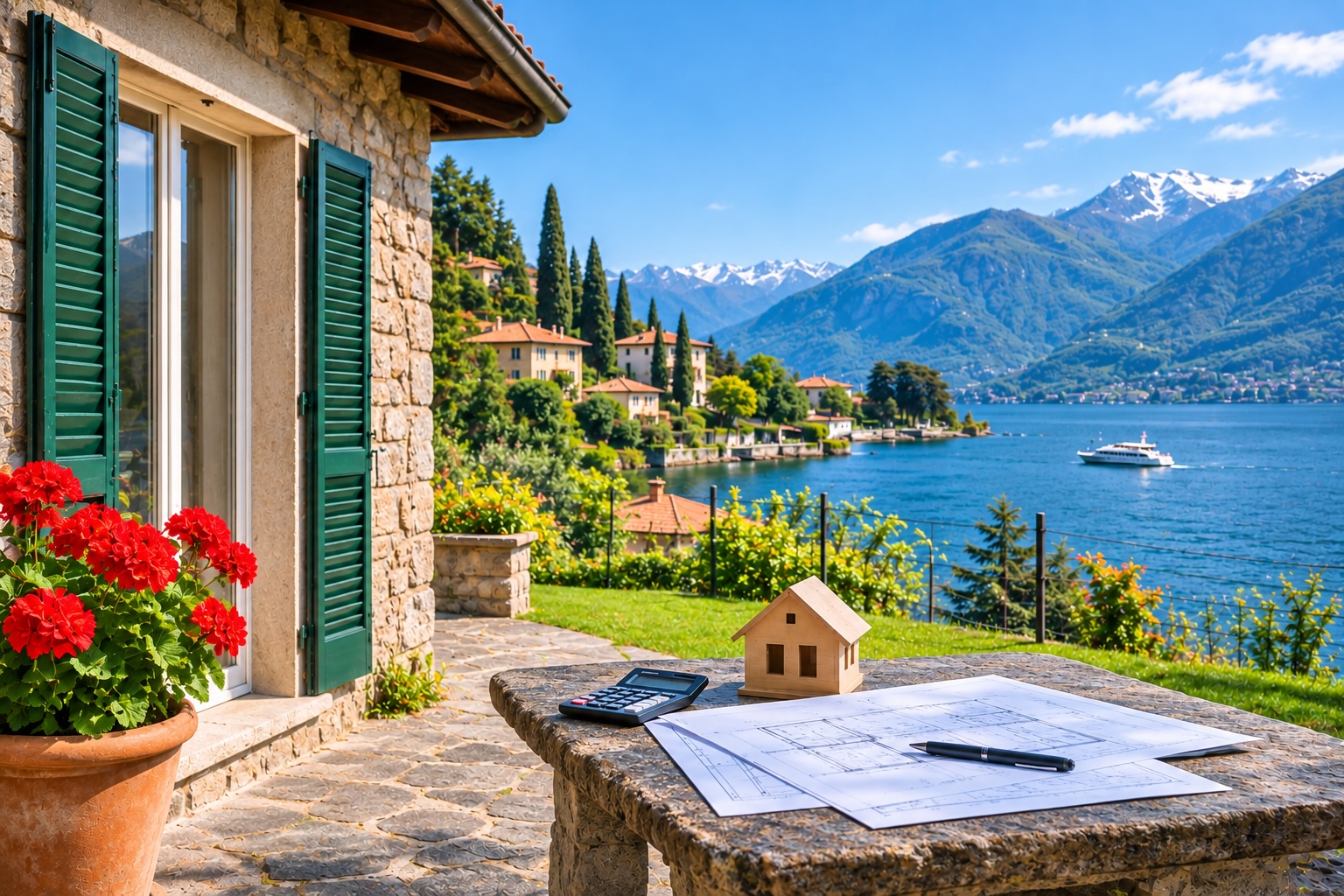
Buying a House on Lake Como: What Does It Really Cost?
Buying a house on Lake Como is an attractive prospect for international buyers looking for a holiday home, a permanent residence or a long-term property investment in Italy. The lake’s distinctive landscape, historic villages and international reputation make it one of the country’s most recognisable real estate destinations. However, understanding the real cost of purchasing a property requires looking beyond the advertised asking price. Taxes, notary fees, estate agency commissions, renovation expenses and ongoing maintenance can all influence the total investment. For buyers considering Northern Lake Como, understanding these costs in advance is essential for establishing a realistic budget and comparing properties effectively.
Property prices around Lake Como vary considerably depending on location, accessibility, building characteristics and proximity to the waterfront. The market includes prestigious villas, traditional village houses, modern apartments and properties requiring renovation, each with a different price structure. Well-known destinations such as Bellagio, Menaggio, Tremezzina and Varenna generally attract substantial international interest, particularly for properties offering panoramic views or direct lake access. Further north, towns such as Domaso, Gravedona ed Uniti, Gera Lario and Colico provide alternatives for buyers interested in a broader selection of residential properties. Although these locations may offer more accessible entry prices than some of the lake’s most exclusive areas, individual property values still depend heavily on condition, position and available amenities.
The asking price is only the starting point when calculating the total cost of buying a house in Italy. One of the most important additional expenses is property taxation, which depends on whether the seller is a private individual or a company and whether the transaction qualifies for specific tax benefits. When purchasing an existing residential property from a private seller, the standard registration tax is generally 9% of the applicable cadastral value, with a minimum of €1,000, rather than 9% of the advertised purchase price, provided the transaction meets the conditions for the prezzo-valore system. Mortgage and cadastral taxes are normally €50 each. Buyers eligible for Italy’s first-home tax benefits may qualify for a reduced registration tax of 2%, subject to the applicable legal requirements. These benefits should not be confused with simply purchasing a property for the first time, as eligibility depends on specific conditions concerning residence, property classification and other factors.
Purchasing a newly constructed property from a developer may involve a different tax structure. When the sale is subject to VAT, the standard rate for an ordinary residential property is generally 10%, while eligible first-home purchases may benefit from a reduced rate of 4%. Luxury residential properties falling within the relevant cadastral categories are generally subject to a 22% VAT rate. Fixed registration, mortgage and cadastral taxes are also payable. Because the tax treatment can significantly affect the overall budget, international buyers should obtain a transaction-specific calculation before committing to a purchase. The distinction between a resale property and a newly built residence can make a substantial difference to the amount of capital required.
Notary fees represent another essential component of the purchasing process. In Italy, the notary is a public official responsible for carrying out important legal checks, preparing and authenticating the deed of sale and ensuring that the transfer is properly registered. The amount payable varies according to the transaction, the property’s value and the complexity of the documentation. Buyers should request a detailed quotation distinguishing the notary’s professional fees from taxes and other amounts collected on behalf of the authorities. If the purchase involves mortgage financing, additional notarial and administrative expenses may apply. International buyers who require translations, interpreters or specialist legal assistance should also include these services in their preliminary budget.
Estate agency commissions must also be considered. In Italy, it is common for the buyer to pay a commission to the estate agent involved in the transaction, although the amount is not established by a single nationwide fixed percentage. Commission rates vary according to the agency, the local market and the agreement between the parties. Buyers should clarify the applicable percentage, whether VAT is included and when the commission becomes payable. These details are particularly important when comparing properties offered through different agencies, as the total acquisition cost may vary even when the asking prices are similar.
A practical example helps illustrate the difference between the purchase price and the total investment. Consider a resale apartment or house advertised at €300,000 in Northern Lake Como. Assuming a private seller, a buyer who does not qualify for first-home benefits and an eligible prezzo-valore transaction, registration tax would be calculated using the property’s cadastral value rather than the €300,000 purchase price. If the applicable taxable cadastral value were €100,000, registration tax would amount to €9,000, plus €100 in fixed mortgage and cadastral taxes. Assuming, purely for illustration, an agency commission of 3% plus 22% VAT, the agency cost would be €10,980. Notary fees and any additional professional expenses would then need to be added. Under these assumptions, the acquisition costs could already exceed €20,000 before including notarial services, moving expenses or improvements. The example demonstrates why buyers should calculate their complete financial commitment rather than relying exclusively on the advertised price.
The condition of the property can have an even greater impact on the final investment. Historic houses and apartments are an important part of Lake Como’s architectural character, but older buildings may require work on electrical installations, plumbing, heating systems, roofing or insulation. Renovation costs depend on the size of the property, the complexity of the interventions and the accessibility of the building. In some historic centres, narrow streets and limited vehicle access can complicate the transportation of materials and equipment, increasing the logistical requirements of construction work. Properties located on steep terrain may present additional challenges involving drainage, retaining walls or external access. A professional technical inspection before purchasing can help identify potential issues and establish whether the renovation budget is compatible with the buyer’s expectations.
Energy efficiency is another factor worth examining carefully. Many traditional Lake Como properties were built before modern insulation standards became common, and their energy performance can differ substantially from that of recently constructed homes. Heating costs, window quality, roof insulation and the efficiency of existing systems should all be evaluated, especially when the property will be occupied during winter. Buyers should review the available Energy Performance Certificate, known in Italy as the Attestato di Prestazione Energetica or APE, and consider whether improvements may be necessary. A property with a lower purchase price but substantial energy renovation requirements may ultimately represent a greater investment than a more expensive home that is already in good condition.
Ownership expenses continue after the purchase has been completed. Depending on the property’s classification and the owner’s circumstances, annual property taxes such as IMU may apply, particularly to second homes. Waste collection charges, utility bills, insurance and routine maintenance should also be included in the annual budget. For apartments within condominium buildings, shared expenses may cover cleaning, lighting, lifts, gardens, heating systems and other communal services. Detached houses require a different approach, as the owner is generally responsible for maintaining the entire building and its external areas. Properties with swimming pools, extensive gardens or private lake access can involve additional maintenance obligations that should be evaluated before purchasing.
For international buyers, currency exchange rates and financing arrangements may introduce further costs. Purchasers using funds held outside the eurozone should consider the effect of exchange rate fluctuations between the initial offer and the completion of the transaction. Mortgage availability and lending conditions can also differ depending on the applicant’s country of residence, income documentation and financial profile. Buyers planning to finance part of the purchase should investigate these conditions early, rather than assuming that mortgage arrangements available in their home country will apply in Italy.
The choice of location influences not only the purchase price but also the practical cost of ownership. A property in the historic centre of Menaggio may offer convenient access to shops, restaurants and ferry connections, potentially reducing the need for frequent car journeys. A house situated above Domaso or Gravedona may provide greater privacy and panoramic views but require a vehicle for everyday activities. In Gera Lario and Colico, buyers may find different combinations of residential convenience, transport connections and access to outdoor activities. These considerations are particularly relevant for owners who intend to spend several months each year on Lake Como rather than using the property exclusively during short holidays.
When comparing properties, buyers should also distinguish between immediate acquisition costs and longer-term financial commitments. A recently renovated apartment with private parking and efficient heating may require a higher initial investment but offer more predictable maintenance expenses. Conversely, a traditional house requiring substantial work may provide an opportunity to create a personalised residence, provided that renovation costs, technical requirements and potential delays have been assessed realistically. Neither option is necessarily more advantageous. The appropriate decision depends on the buyer’s available capital, intended use and willingness to manage future improvements.
Buying a house on Lake Como is therefore not simply a question of identifying an attractive property within a particular price range. It requires a clear understanding of the relationship between purchase price, taxation, professional fees, building condition and ongoing ownership expenses. Northern Lake Como offers a varied property market, with opportunities in Menaggio, Domaso, Gravedona, Gera Lario and Colico that deserve to be evaluated according to their individual characteristics rather than broad assumptions about the lake’s property values. Working with a local real estate agency familiar with the Alto Lario market, together with qualified legal and technical professionals, can help international buyers establish a realistic budget and approach the purchasing process with greater confidence. The real cost of buying a house on Lake Como is ultimately the amount required not only to acquire the property, but also to maintain and enjoy it comfortably over time.